
Selecting the correct fastening solution is critical in industrial manufacturing, construction, pallet production, and structural woodworking. Among the most commonly used fastening options, ring shank coil nails and smooth shank coil nails are widely applied across high-volume industrial environments.
Although these two nail types may appear similar at first glance, their holding performance, withdrawal resistance, installation behavior, and long-term durability differ significantly. Understanding these differences is essential for manufacturers, distributors, and contractors seeking reliable fastening performance and cost control.
This guide provides a detailed comparison between ring shank and smooth shank coil nails, helping buyers select the most suitable option for different industrial applications.
Table of Contents
Understanding Coil Nail Shank Designs: Ring Shank vs Smooth Shank Coil Nails
What Are Smooth Shank Coil Nails
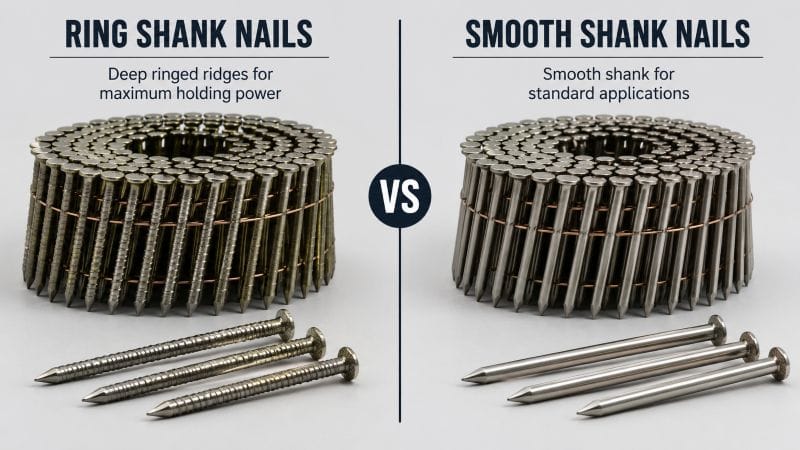
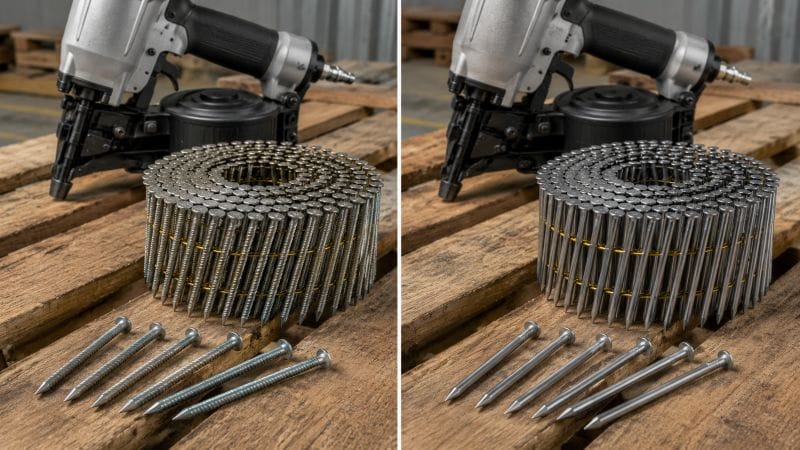
Smooth shank coil nails feature a plain surface without ridges or threads along the nail body. Their simple design allows easy penetration into wood and fast installation speed.
Because of lower driving resistance, smooth shank nails are commonly used in applications where high withdrawal resistance is not the primary requirement.
Typical applications include:
- Temporary wooden structures
- Light-duty pallets
- Interior framing
- General construction work
Smooth shank coil nails are widely preferred when installation speed and lower material cost are priorities.
What Are Ring Shank Coil Nails
Ring shank coil nails contain circular ridges along the nail shank. These rings compress surrounding wood fibers during installation, creating significantly stronger holding force once the wood fibers expand around the nail body.
This design greatly improves withdrawal resistance and long-term fastening stability.
Ring shank coil nails are commonly used in:
- Industrial pallet manufacturing
- Export wooden packaging
- Structural wood assemblies
- Flooring systems
- Roofing applications
Their superior grip makes them especially suitable for projects exposed to vibration, movement, or heavy loads.
Structural Differences Between Ring Shank and Smooth Shank Nails
The primary difference lies in the nail surface geometry.
| Feature | Smooth Shank Coil Nails | Ring Shank Coil Nails |
|---|---|---|
| Surface Design | Smooth | Circular ridges |
| Installation Resistance | Lower | Higher |
| Withdrawal Resistance | Moderate | Very high |
| Holding Power | Standard | Superior |
| Installation Speed | Faster | Slightly slower |
| Best Use | Light-duty applications | Heavy-duty industrial projects |
Although smooth shank nails install faster, ring shank nails provide substantially stronger long-term fastening performance.
Why Withdrawal Resistance Matters
Understanding Withdrawal Failure
Withdrawal failure occurs when nails gradually loosen from wood due to vibration, load shifting, moisture expansion, or repeated movement.
This issue is particularly common in:
- Shipping pallets
- Roofing systems
- Outdoor wood structures
- Industrial packaging
Weak withdrawal resistance can compromise structural integrity and increase maintenance costs.
How Ring Shank Nails Improve Grip
The ridges on ring shank coil nails create friction and mechanical locking inside the wood fibers.
This results in:
- Better load stability
- Reduced loosening over time
- Improved structural durability
- Higher resistance to transportation vibration
For industrial environments, this performance advantage is often critical.
Applications: Ring Shank vs Smooth Shank Coil Nails
Light-Duty Pallet Manufacturing
Smooth shank nails are sometimes used in lower-cost pallet production where load requirements are moderate.
Advantages include:
- Lower nail cost
- Faster installation
- Reduced driving resistance
However, they are generally less suitable for reusable or export pallets exposed to heavy transport conditions.
Interior Construction
Indoor framing and temporary structures often use smooth shank coil nails because moisture exposure and structural stress are lower.
High-Speed Production Environments
Factories prioritizing production speed sometimes choose smooth shank nails due to reduced pneumatic driving resistance.
Applications of Ring Shank Coil Nails
Industrial Pallet Production
Ring shank coil nails are widely recognized as one of the best fastening solutions for industrial pallets.
Their strong holding power helps pallets maintain structural stability during:
- Forklift handling
- Long-distance transportation
- Heavy cargo stacking
Export Packaging
Export wooden crates and industrial packaging require strong fastening due to repeated handling and shipping vibration.
Ring shank nails reduce the risk of board separation during international transportation.
Roofing Systems
Roofing applications require strong withdrawal resistance to withstand wind uplift and environmental movement.
Ring shank roofing nails significantly improve roof durability and safety.
Structural Wood Construction
Heavy-duty wood assemblies benefit from the superior holding force of ring shank fasteners.
Comparing Installation Efficiency
Smooth Shank Installation Speed
Smooth shank nails penetrate wood more easily because they generate less friction during installation.
Benefits include:
- Faster driving speed
- Lower air pressure requirements
- Reduced equipment strain
This can improve efficiency in certain high-volume production environments.
Ring Shank Installation Performance
Although ring shank nails require slightly more driving force, modern pneumatic nail guns handle them efficiently.
The slight reduction in speed is often offset by improved long-term durability and reduced repair costs.
Corrosion Resistance Considerations
Both smooth shank and ring shank coil nails are available with different surface coatings.
Bright Finish
Suitable for dry indoor environments where corrosion risk is minimal.
Electro-Galvanized Coating
Provides moderate corrosion resistance for general industrial use.
Hot-Dip Galvanized Coating
Recommended for:
- Outdoor applications
- Humid environments
- Export pallets
- Roofing systems
Stainless Steel Options
Used in coastal or highly corrosive environments requiring maximum durability.

Ring Shank vs Smooth Shank in Pallet Manufacturing
Pallet manufacturing is one of the most important industrial applications for coil nails.
The following comparison highlights practical differences.
| Performance Factor | Smooth Shank | Ring Shank |
|---|---|---|
| Production Speed | Higher | Moderate |
| Holding Strength | Medium | High |
| Vibration Resistance | Moderate | Excellent |
| Export Pallet Suitability | Limited | Highly suitable |
| Long-Term Durability | Standard | Superior |
| Reusable Pallet Performance | Lower | Much better |
For most industrial pallet factories, ring shank coil nails provide significantly better long-term performance.
Cost Comparison and Long-Term Value
Initial Material Cost
Smooth shank nails are generally less expensive due to simpler manufacturing.
Long-Term Operational Cost
Ring shank nails may have slightly higher upfront cost, but they often reduce:
- Pallet repair rates
- Product damage
- Structural failure risk
- Customer complaints
For industrial buyers, long-term value is usually more important than initial unit price.
How to Choose the Right Coil Nails for Your Application
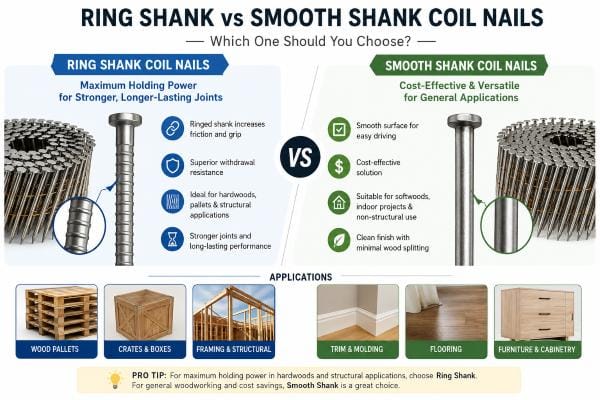
Choose Smooth Shank Coil Nails If:
- Installation speed is the highest priority
- The application is temporary or light-duty
- Budget control is critical
- Structural stress is relatively low
Choose Ring Shank Coil Nails If:
- Long-term holding strength is required
- Products are exposed to vibration or movement
- Pallets are used for export shipping
- Structural durability is important
Common Procurement Mistakes
Choosing Based Only on Price
Many buyers focus only on initial cost without considering long-term performance.
Low-cost fastening may increase maintenance and replacement expenses later.
Ignoring Application Environment
Moisture exposure, transportation vibration, and structural load should always influence nail selection.
Using Incorrect Nail Specifications
Incorrect nail length or diameter can reduce fastening performance and damage wood materials.
How Reliable Manufacturers Improve Nail Quality
Professional coil nail manufacturers maintain strict quality standards through:
- Automated production systems
- Precise dimensional control
- Stable steel wire sourcing
- Coating inspection systems
- Mechanical performance testing
Consistent manufacturing quality is essential for industrial fastening applications.
Future Trends in Industrial Fastening
Higher Demand for Durable Fastening
Industrial buyers increasingly prioritize durability and long-term performance over lowest-cost solutions.
Growth of Automated Production
As pallet and construction factories adopt automation, demand for consistent high-quality coil nails continues to increase.
Stronger Export Packaging Standards
Global logistics systems require more reliable pallet structures, increasing demand for ring shank fastening solutions.
Conclusion
Both ring shank and smooth shank coil nails have important roles in industrial fastening applications. Smooth shank nails provide speed and cost advantages for light-duty projects, while ring shank coil nails deliver superior holding strength and long-term durability.
For industrial pallet manufacturing, export packaging, roofing, and structural woodworking, ring shank coil nails are often the preferred solution due to their excellent withdrawal resistance and stability.
Choosing the correct nail type based on application requirements, environmental conditions, and long-term performance goals helps manufacturers improve product quality, reduce operational costs, and enhance customer satisfaction.
FAQ
Are ring shank coil nails stronger than smooth shank nails?
Yes. Ring shank coil nails provide significantly higher withdrawal resistance and holding strength.
Which nail type is better for pallets?
Ring shank coil nails are generally preferred for industrial pallets and export packaging because of their stronger grip.
Are smooth shank nails cheaper?
Yes. Smooth shank nails usually have lower manufacturing and purchasing cost.
Can ring shank nails be used for roofing?
Yes. Ring shank roofing nails are widely used because they improve wind resistance and long-term roof stability.