Analysis of how pneumatic systems and robotic integration are redefining technical specifications for industrial-grade coil nails in global infrastructure.
In 2026, the wave of global industrialization in construction is fundamentally transforming traditional construction methods. With the continued rise in global labor costs, especially in emerging markets in North America, Europe, Australia, and Southeast Asia, the pursuit of maximum project turnover and construction precision has become crucial for the survival of construction companies. In this macro-process, the widespread adoption of pneumatic nailing systems, automated prefabricated component production lines, and construction robots is profoundly changing the technical specifications and quality thresholds of the fastener sub-sector.
Automated construction demands a “zero-tolerance” mechanism for precision.
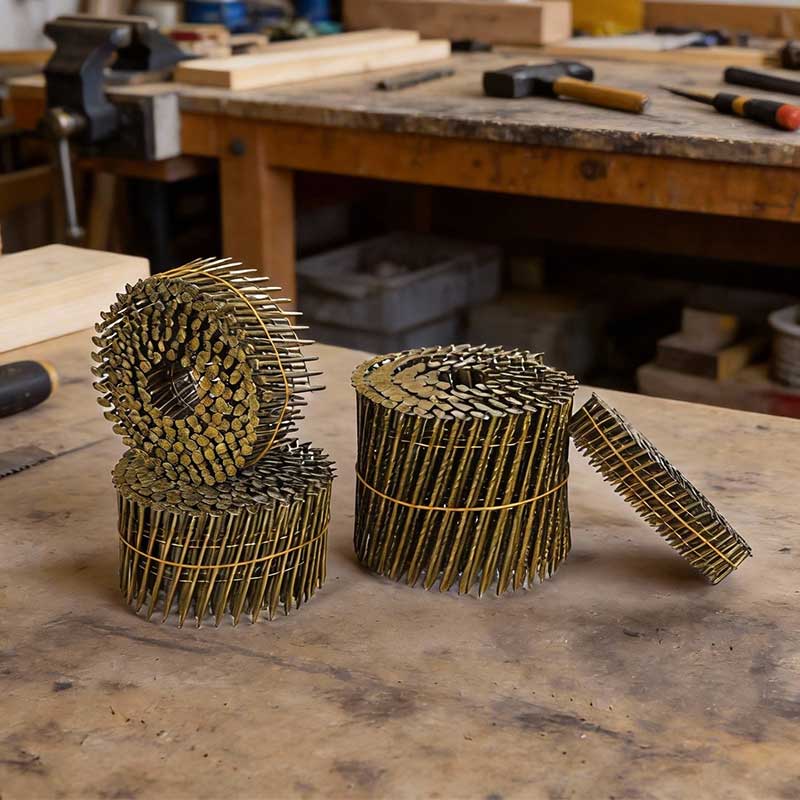
In the past few decades of manual construction, carpenters could fine-tune the angle and force of nailing based on experience, even with minute deviations in the nails. However, for automated equipment with a firing frequency of 300 to 500 times per minute, any tiny dimensional error can bring the entire production line to a standstill. Modern construction’s demand for coil nails has evolved from simple “connectors” to “precision industrial consumables.” The requirements for geometric precision are extremely high, including the symmetry of the nail tip, the straightness tolerance of the nail body, and the uniformity of wire collating. The wire bonding process plays a decisive role. Industry research indicates that uneven weld strength or a wire spacing deviation exceeding 0.2 mm can easily lead to continuous jamming under the high-speed friction of the pneumatic gun barrel. For large precast building component factories, a single unplanned downtime caused by consumables can result in a direct loss of thousands of dollars in production capacity. Therefore, the global high-end construction market’s demand for fasteners with “high consistency and precision” attributes is climbing at an astonishing compound annual growth rate, forcing manufacturers to implement precise digital monitoring from the raw material drawing stage.
The profound interplay of materials science:
hardness, toughness, and lifespan. The growing concern for building safety extends to every micro-level detail of a building. Modern building structures are becoming increasingly complex, with the application of high-density composite materials, thickened light steel framing, and new environmentally friendly wood, placing higher demands on the penetration power of fasteners. Fasteners are no longer simply low-carbon steel products, but rather the culmination of materials science. The use of high-carbon steel, coupled with precisely controlled quenching and tempering processes, has become an industry consensus for producing high-strength products. This process ensures that coil nails, when driven into extremely high-density hardwood, possess sufficient hardness to prevent breakage or bending, while also possessing the necessary ductility to absorb tangential stress and vibration from within the structure, preventing the risks of brittle fracture.
Surface Treatment Innovations Under Extreme Climate Challenges
With increasingly frequent global climate anomalies, the built environment has become more complex and corrosive than ever before. High salt spray environments in coastal areas, acid rain erosion in industrial cities, and extreme humidity in tropical regions all pose challenges to the lifespan of fasteners. Traditional galvanizing processes are no longer sufficient to fully meet the design life of buildings lasting 50 years or more. Therefore, the industry is promoting more advanced surface treatment solutions. These include the optimization of hot-dip galvanizing technology, the application of mechanical galvanizing, and the latest nano-ceramic composite coatings. The application of these technologies aims to significantly improve the oxidation resistance of fasteners through multiple layers of physical and chemical barriers, thereby extending the structural safety life of the entire building.
The Future of Industry Standardization and Traceability:
The future global construction supply chain will move towards full transparency. With the widespread adoption of digital jobsites and BIM (Building Information Modeling) systems, each batch of steel coils entering a construction site will have its own unique “digital passport.” This passport will record the chemical composition of the material, tensile strength test data, heat treatment curves, and surface coating thickness. This end-to-end traceability from the steel mill to the construction site is not only a guarantee of project quality but also a core consideration for large global contractors when selecting long-term strategic partners.