The vital role of high-performance coil nails in ensuring the structural integrity and recyclability of global logistics packaging solutions.
The recovery of global trade and the explosion of cross-border e-commerce have directly propelled the leapfrog development of the logistics packaging industry. Wooden pallets and wooden crates, as the most standardized load-bearing units in global logistics transportation, have seen explosive growth in consumption. However, under the dual pressures of optimizing logistics costs and environmental compliance, the industry has begun to focus on a previously overlooked key aspect: fasteners—especially coil shanks—and their impact on the entire packaging lifecycle.
Structural Integrity: Analyzing the Physics of Pull-Out Force In modern, high-standard automated sorting centers, wooden pallets frequently withstand high-speed loading and unloading by forklifts, high-pressure stacking, and continuous mechanical vibrations for dozens of days during sea freight. Industry data analysis shows that the main cause of pallet failure is often not the breakage of the wood itself, but rather the structural disintegration caused by loose fasteners. Traditional smooth nails are prone to “nail slippage” under continuous micro-vibrations, which can lead to the tipping or even damage of entire pallets in critical freight processes.
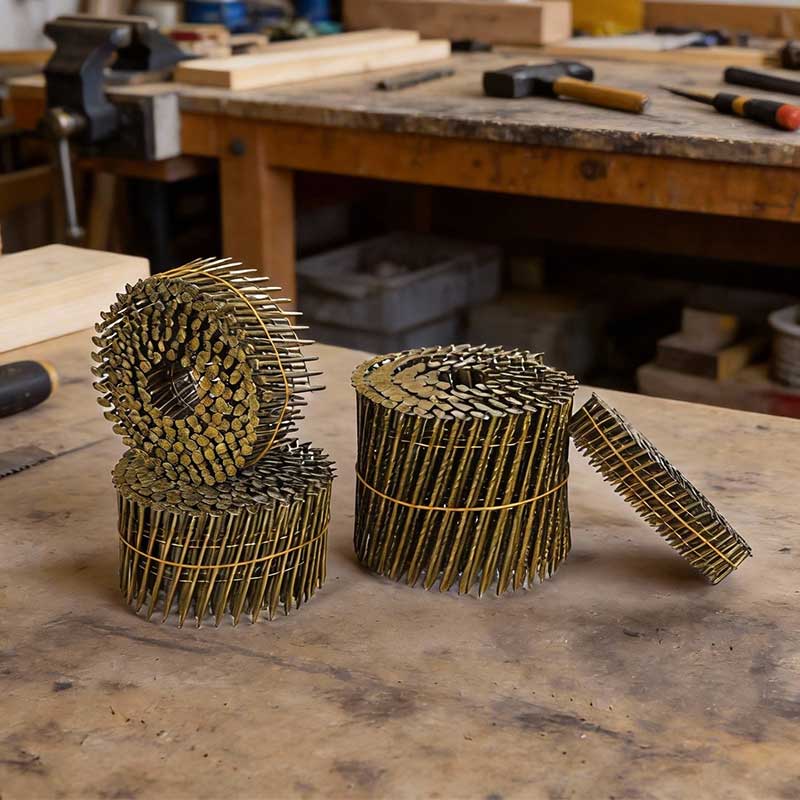
To address this pain point, threaded and ring-shank coil shanks have become the mainstream choice in the international high-end packaging market. Its ingenious design lies in utilizing the geometric texture of the nail’s surface. Upon driving it into the wood, the wood fibers undergo physical deformation and become tightly wrapped within the grain, generating significant mechanical resistance. This screw-like fastening effect provides several times the pull-out force of ordinary nails, greatly ensuring the structural stability of goods in the extreme and dynamic environment of transoceanic transport.
Green Supply Chain: Wood Recycling and Environmental Premium In today’s world, where “carbon neutrality” has become a global consensus, the logistics industry is committed to building a closed-loop circular economy system. The recycling, repair, and reuse of wooden pallets are central to achieving this goal. This requires that the fasteners used possess a certain degree of “environmental friendliness.” On the one hand, the nail tip design of high-quality coil nails effectively reduces tearing of wood fibers during driving, preventing wood cracking and thus increasing the repair frequency of a single pallet by more than 20%. On the other hand, the dismantling of discarded pallets and metal recycling also require that the fastener material be easily scavenged by magnets and recycled.
Furthermore, with increasingly stringent chemical regulations (such as the RoHS Directive and REACH regulations) in markets like Europe and the United States, the presence of harmful heavy metals like lead and chromium in the anti-corrosion coating of fasteners has become a crucial benchmark for assessing a supplier’s global supply capabilities. Fasteners with environmentally friendly coating technology not only represent technological strength but also serve as a market passport, helping packaging companies mitigate compliance risks in international trade.
The Driving Force of Global Logistics Standardization and Market Gap: With the deepening implementation of the International Plant Protection Convention (IPPC) standard for wood packaging management (ISPM 15) globally, fastener performance and the effectiveness of wood heat treatment are mutually reinforcing. In many emerging markets, the packaging industry is undergoing a transformation from “random procurement” to “specialized supply.” The market is no longer satisfied with simply “fastening,” but demands customized fastening solutions adaptable to specific wood species (such as pine, poplar, and hardwoods). This deep adaptation to application scenarios is driving global fastener manufacturers to continuously invest in R&D to fill the significant gap in the high-end customized fastener market.
Conclusion: Details Determine New Heights in Logistics Safety. Although fasteners account for a very small percentage of the overall cost of logistics packaging, their contribution to overall safety and durability is enormous. In the future, with the further evolution of smart logistics, coil nails, with their long-lasting corrosion resistance and superior locking capabilities, will become silent heroes supporting the efficient operation of the global supply chain.