

Table of Contents
A coil nail salt spray test report can help answer a defined coating-quality question. It cannot, by itself, tell you how many years a nail will last outdoors. Before accepting a headline number of exposure hours, identify the tested product, the test method, and exactly what counted as failure.
This guide is for purchasing and quality teams reviewing a coil nail salt spray test supplied with a quotation or production sample. The aim is to decide whether the report supports the proposed order, needs clarification, or is being used to support a claim it cannot establish. The checklist is a purchasing aid, not a laboratory operating procedure.
Decide What the Report Needs to Prove
Start a coil nail salt spray test review with the decision you need to make. Are you checking consistency of a previously approved coating process, investigating a suspected surface defect, or selecting protection for a new environment? Those are different questions. A report useful for one purpose may be insufficient for another.
Write the purpose of the coil nail salt spray test in the enquiry. For example, a repeat-order review might ask whether the submitted sample matches the agreed coating specification and assessment criteria. An outdoor application review also needs the service conditions and relevant material-selection evidence. Do not let the availability of a test certificate define the engineering question.
Check the Method Behind the Number
For a coil nail salt spray test citing ASTM B117, verify the edition and the laboratory’s stated procedure. ASTM B117-26 describes the controlled salt-fog environment. It does not prescribe a product-specific exposure duration or explain what result constitutes acceptance for your nail order. Those requirements must be defined separately.
If the coil nail salt spray test cites ISO 9227, identify the actual procedure. The standard covers neutral salt spray, acetic acid salt spray, and copper-accelerated acetic acid salt spray. Do not treat reports using different procedures as equivalent simply because both mention ISO 9227. Record the method and applicable revision alongside the exposure period.
Trace the Specimen Back to the Order
A coil nail salt spray test belongs to the specimens identified in the report. Check the sample reference against the quotation, drawing revision, production batch, and finish description. A certificate for another fastener or an unidentified coated panel is not automatically evidence for the coil nails being offered.
Ask whether the coil nail salt spray test used a complete coil, separated collated nails, or loose specimens prepared specifically for testing. Record any cutting, handling, masking, or deliberate damage. Photographs should show the starting condition and the assessed surfaces. This matters when interpreting observations near a cut, contact point, nail head, or collation weld.
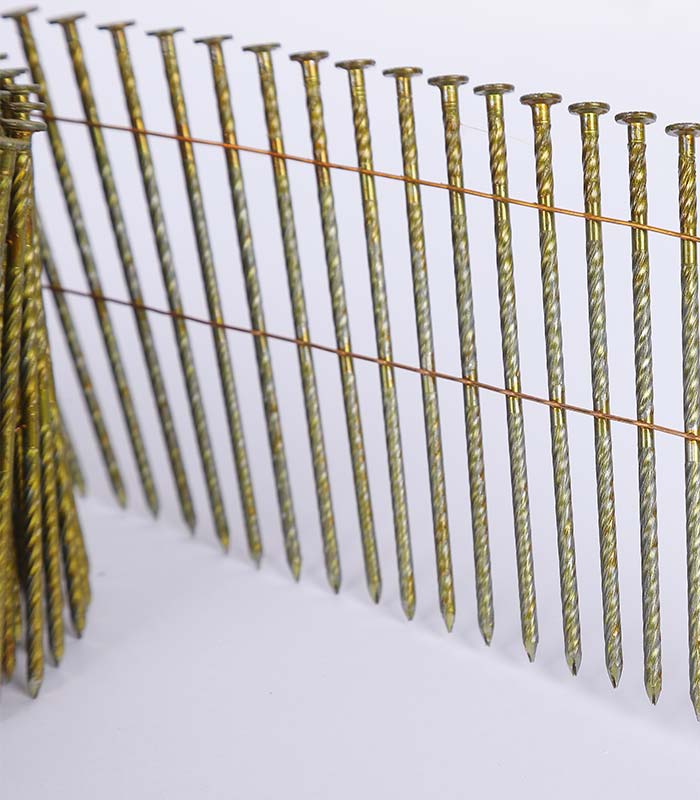
Keep the coating description specific. A colour photograph does not establish the coating process, thickness, or supplementary treatment. Refer to the agreed coil nail surface finish specification when checking the paperwork, and ask the supplier to resolve differences between commercial names and the technical description.
Read the Corrosion Endpoint Before Pass or Fail
The conclusion of a coil nail salt spray test is only meaningful when the assessed condition is defined. Request the stated corrosion category, assessed area, treatment of edges or contact marks, and inspection interval. A report describing one surface change cannot be compared directly with another report assessing a different condition.
Distinguish a specimen that met the criterion when testing stopped from one monitored until the first recorded failure. In a coil nail salt spray test, an end-of-exposure photograph is not evidence of the exact time a defect first appeared. Keep the original observation wording rather than translating every outcome into hours until rust.
Put Comparable Details Side by Side
Use the following comparison sheet when reviewing more than one coil nail salt spray test. Missing information should remain marked as unresolved, not filled in from assumptions. The purpose is to expose differences in the evidence before a purchasing team ranks suppliers by a single headline result.
| Report detail | Record for each submission | Reason to pause comparison |
|---|---|---|
| Product identity | Sample code, drawing, batch, and coating specification | The tested item cannot be linked to the quotation |
| Exposure method | Standard revision, procedure, and stated duration | Methods or exposure schedules differ |
| Specimen condition | Preparation, assessed areas, and before-test photographs | One sample was altered but the other was not |
| Assessment | Defined endpoint and inspection observations | Pass and fail mean different things |
| Scope of conclusion | What the laboratory actually concludes | A sales claim goes beyond the reported result |
Request the complete coil nail salt spray test report rather than a cropped certificate or one selected photograph. Keep the issuer, report identifier, date, and any qualifications attached to the result. Where independent verification is needed, contact the laboratory through its published contact details and ask it to confirm the document and sample scope.
Do Not Convert Chamber Hours Into Outdoor Years
ASTM B117 cautions that standalone salt-spray results generally do not predict natural exposure reliably. A coil nail salt spray test therefore should not be converted into a fixed outdoor lifetime by applying a simple multiplier. A longer reported exposure also does not establish universal superiority across different coating systems and service environments.
For hot-dip galvanized steel, the American Galvanizers Association explains the limitations of these comparisons. Continuous salt fog does not reproduce the conditions under which protective zinc corrosion products develop outdoors. Its guidance warns against using salt-spray testing to predict hot-dip galvanized service performance or compare unrelated coating technologies.
Turn the Review Into a Clear Purchasing Decision
Close the coil nail salt spray test review with a written decision: relevant evidence accepted for the defined purpose, clarification required, or further assessment needed. Keep unresolved coating, specimen, and application questions visible. Do not approve an exposure requirement retrospectively just because the available report happens to meet it.
Yizhengyu’s coated coil nail range provides a starting point for a specification enquiry. Send the intended environment, nail drawing, coating requirement, and the evidence your customer requires. Ask whether a relevant coil nail salt spray test is available for the exact proposed specification; do not assume that a catalogue listing includes a particular test result or certification.
FAQ
Does a coil nail salt spray test prove outdoor service life?
No. Laboratory exposure is not a direct outdoor lifetime measurement. Select the coating using the application requirements and appropriate service-performance evidence, not a conversion from chamber hours to years.
What exposure duration should a coil nail salt spray test use?
Use the duration and acceptance criteria required by the applicable product specification or agreed assessment plan. A test-method reference alone does not supply a universal requirement for every nail.
Can a coil nail salt spray test on loose nails support a coil order?
Only after the responsible reviewer establishes its relevance. Confirm the product and coating identity, specimen preparation, and whether collation or other differences affect the question being assessed.
Is a longer coil nail salt spray test result always better?
Not across unmatched methods, specimens, endpoints, or coating systems. First establish that the comparison is meaningful, then assess the result within that defined scope.
What should a coil nail salt spray test report include?
Request the complete report, traceable sample identity, method and revision, exposure details, preparation notes, assessment criteria, and photographs. This is a review checklist, not a substitute for the laboratory’s reporting requirements.


