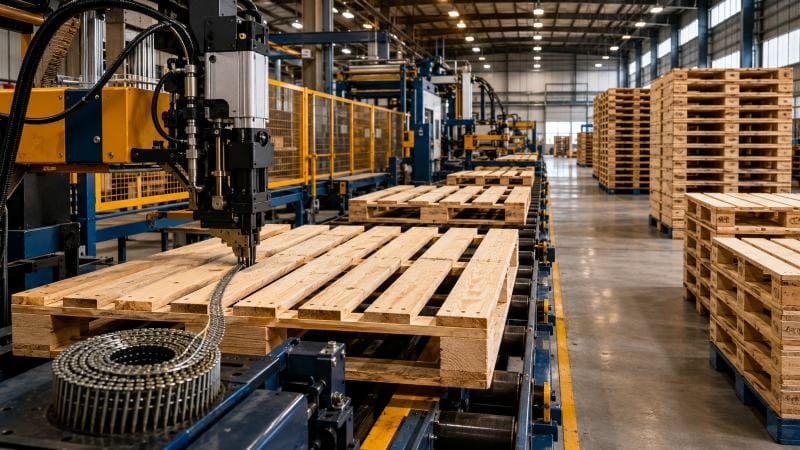
In the pallet manufacturing industry, efficiency directly impacts production costs, delivery speed, and overall profitability. As global demand for wooden pallets continues to grow across logistics, warehousing, export packaging, and industrial transportation, manufacturers are under increasing pressure to improve output while maintaining consistent quality.
One of the most important factors in pallet production is the fastening system. Choosing the right fastening solution can significantly improve assembly speed, structural stability, and operational efficiency. This is why coil nails have become the preferred choice for modern pallet manufacturing lines.
This guide explains how coil nails improve pallet production efficiency, explores the best nail types for pallet assembly, and provides practical insights for pallet manufacturers, importers, and industrial buyers.
Why Fastening Matters in Pallet Manufacturing
The Role of Nails in Pallet Strength
Wooden pallets are constantly exposed to heavy loads, vibration, stacking pressure, and environmental stress during transportation and storage. The quality of fastening directly affects pallet durability and load-bearing capacity.
Weak or unsuitable nails may cause:
- Loose pallet boards
- Structural instability
- Increased product damage during transport
- Higher maintenance and replacement costs
Using high-quality coil nails helps manufacturers produce stronger and more reliable pallets.
Production Speed and Labor Efficiency
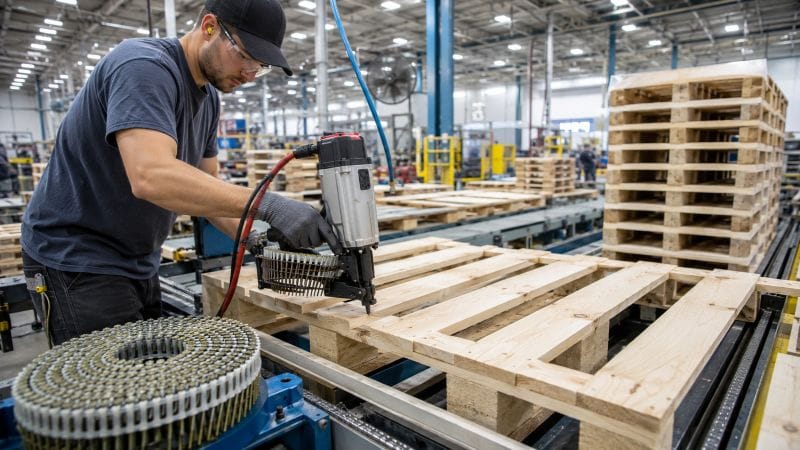
Modern pallet factories operate at high production volumes. Traditional loose nails slow down the assembly process because workers must reload frequently and spend more time handling materials.
Coil nails significantly reduce downtime by allowing continuous fastening with pneumatic nail guns. This improves assembly speed and reduces labor intensity.
What Are Coil Nails
Structure and Design
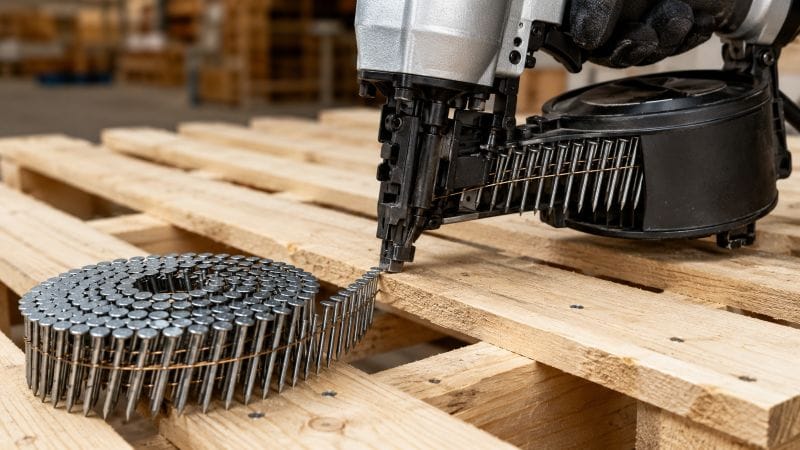
Coil nails are collated nails arranged in a coil shape and connected using wire, plastic, or other materials. They are designed for pneumatic nail guns and automated fastening systems.
Compared with strip nails or loose nails, coil nails offer:
- Higher nail capacity per load
- Faster installation speed
- Reduced downtime
- More stable feeding performance
Why Coil Nails Are Ideal for Pallet Production
Pallet manufacturing requires repetitive fastening across large volumes of wood components. Coil nails are ideal because they support continuous operation and consistent fastening quality.
Their design allows manufacturers to improve workflow efficiency and reduce production interruptions.
How Coil Nails Improve Pallet Production Efficiency
Faster Assembly Speed
One of the biggest advantages of coil nails is high-speed installation. Pneumatic nail guns loaded with coil nails can drive hundreds of nails quickly without frequent reloading.
This improves:
- Daily production output
- Worker productivity
- Manufacturing consistency
In large pallet factories, even small reductions in assembly time can significantly increase total production capacity.
Reduced Labor Costs
Using coil nails reduces manual handling and minimizes downtime caused by reloading. Workers can complete more pallets in less time, lowering labor costs per unit.
This is especially important for factories operating large-scale pallet production lines.
Improved Fastening Consistency
Consistent nail placement is essential for pallet quality. Coil nails work with automated nail guns to ensure uniform penetration depth and stable fastening.
This reduces:
- Nail misalignment
- Structural weakness
- Product rejection rates
Better Compatibility with Automated Production Lines
Modern pallet production increasingly relies on automated systems. Coil nails are designed for compatibility with industrial pneumatic equipment and robotic assembly lines.
Their stable feeding performance helps prevent:
- Nail jams
- Machine downtime
- Production interruptions
Common Types of Coil Nails Used in Pallet Manufacturing
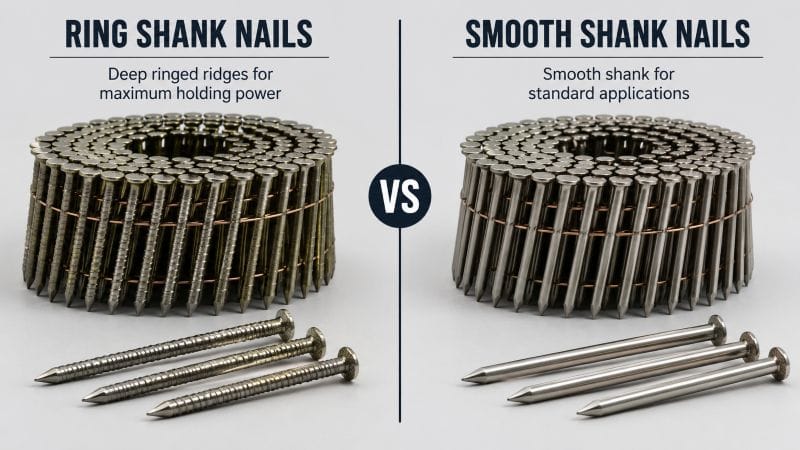
Smooth Shank Coil Nails
Smooth shank nails are suitable for light-duty pallets and lower-cost applications.
Advantages include:
- Easier penetration
- Lower material cost
- Faster driving speed
However, they offer lower withdrawal resistance compared with ring or screw shank nails.
Ring Shank Coil Nails
Ring shank coil nails are the most widely used option in pallet manufacturing.
The ridges along the shank improve holding power and help prevent loosening during transportation.
Advantages include:
- Strong grip
- Better vibration resistance
- Improved pallet durability
Screw Shank Coil Nails
Screw shank nails provide maximum holding strength for heavy-duty pallets.
They are commonly used for:
- Export pallets
- Heavy industrial loads
- Long-term pallet reuse
Comparison of Coil Nail Types for Pallet Production
| Nail Type | Holding Power | Production Efficiency | Best Applications |
|---|---|---|---|
| Smooth Shank | Medium | High | Light-duty pallets |
| Ring Shank | High | High | Standard industrial pallets |
| Screw Shank | Very High | Medium | Heavy-duty export pallets |
This comparison shows why ring shank coil nails are often considered the best balance between efficiency and performance.
Choosing the Right Coil Nails for Pallet Manufacturing
Nail Length and Diameter
Selecting the correct nail size is essential for pallet stability.
Typical specifications include:
| Specification | Common Range |
|---|---|
| Nail Length | 45mm – 90mm |
| Nail Diameter | 2.5mm – 3.3mm |
Longer and thicker nails provide stronger fastening for heavy-duty pallets.
Surface Coatings
Different environments require different corrosion protection levels.
Bright Coil Nails
Suitable for indoor pallet applications with low humidity exposure.
Electro-Galvanized Coil Nails
Provide moderate corrosion resistance for general industrial use.
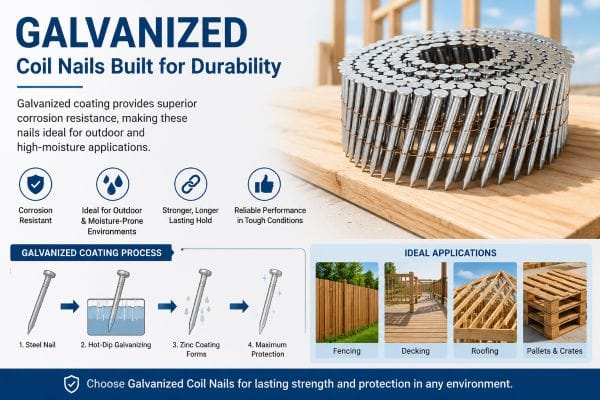
Hot-Dip Galvanized Coil Nails
Ideal for outdoor storage, humid conditions, and export pallets.
Nail Gun Compatibility
Manufacturers should ensure coil nails match their pneumatic nail gun specifications, including:
- Coil angle
- Nail diameter
- Collation type
Incorrect compatibility may reduce efficiency and increase machine wear.
How Coil Nails Reduce Operational Costs
Lower Maintenance Costs
Strong fastening reduces pallet damage and decreases repair frequency.
Reduced Material Waste
Consistent nail driving reduces split wood and defective pallets.
Improved Production Stability
Fewer jams and interruptions improve workflow continuity and reduce downtime.
Better Long-Term Profitability
Higher production efficiency and reduced labor costs help improve overall manufacturing profitability.
Common Problems in Pallet Production Without Quality Coil Nails
Nail Jamming
Low-quality nails may deform or feed inconsistently, causing production delays.
Weak Fastening
Poor nail quality can reduce pallet durability and increase failure risk.
Corrosion Issues
Insufficient coating protection may cause rust in humid environments.
Increased Equipment Wear
Inconsistent nail dimensions can damage pneumatic nail guns over time.
How to Choose a Reliable Coil Nail Supplier
Evaluate Production Capacity
Reliable manufacturers should have automated production lines capable of handling bulk orders consistently.
Verify Quality Control Systems
Consistent product quality is essential for industrial pallet production.
Manufacturers should conduct:
- Raw material inspection
- Dimensional testing
- Coating inspection
- Mechanical strength testing
Request Samples
Testing samples before placing bulk orders helps verify compatibility and performance.
Assess Export Experience
Experienced exporters understand packaging standards, logistics requirements, and international quality expectations.
Why More Pallet Manufacturers Prefer Bulk Coil Nails
Bulk coil nails provide several operational advantages:
- Stable supply chain
- Lower procurement costs
- Better inventory management
- Improved production planning
For growing pallet manufacturers, bulk purchasing also improves long-term cost efficiency.
Future Trends in Pallet Manufacturing Fastening Systems
Increased Automation
Automated pallet production lines will continue to increase demand for high-quality coil nails.
Higher Durability Requirements
As logistics systems become more demanding, stronger fastening solutions will become increasingly important.
Sustainable Packaging Industry Growth
Global demand for export pallets and industrial packaging continues to grow, increasing the need for efficient fastening systems.
Conclusion
Coil nails play a critical role in improving pallet production efficiency. Their compatibility with pneumatic nail guns, fast installation speed, and strong holding power make them the preferred fastening solution for modern pallet manufacturing.
By selecting the right coil nail type, coating, and supplier, manufacturers can improve production efficiency, reduce operational costs, and produce stronger, more durable pallets.
For businesses involved in pallet production, investing in high-quality coil nails is not just a purchasing decision — it is a long-term strategy for improving productivity and competitiveness.
FAQ
Why are coil nails better for pallet manufacturing?
Coil nails improve production speed, reduce downtime, and provide stronger fastening compared with loose nails.
Which coil nails are best for pallets?
Ring shank coil nails are commonly preferred because they provide strong holding power and excellent vibration resistance.
Can coil nails reduce pallet production costs?
Yes, they improve labor efficiency, reduce material waste, and minimize maintenance costs.
Are galvanized coil nails necessary for pallets?
Galvanized coil nails are recommended for outdoor storage, export pallets, and humid environments to prevent corrosion.