
Table of Contents
Pallet nail clinching means deliberately bending the projecting point after a nail passes through the connected wood members. It is part of a specified connection, not a repair for every nail that comes out underneath a board. The first buying question is therefore whether the pallet drawing calls for a clinched joint at that location.
For pallet manufacturers and coil nail buyers, pallet nail clinching creates a different selection problem from ordinary nailing into a thick stringer or block. The fastener must reach through the joint and form the intended bend using suitable equipment. A correctly fed coil and a neatly seated head do not establish that the underside connection is acceptable.
When a Bent Point Is Intentional
Begin with a section drawing of the connection. Identify the entry face, every wood layer the nail crosses, and the surface where its point should emerge. Mark which joints require pallet nail clinching and which require the point to remain embedded. A general instruction such as use pallet nails leaves this distinction unresolved.
The USDA Forest Products Laboratory describes clinching in its Wood Handbook chapter on fastenings. It reports improved withdrawal resistance for clinched smooth-shank nails, but emphasizes that the result depends on wood species, moisture, nail size, and bend direction relative to the grain. Those observations do not provide a universal strength multiplier for commercial coil nails.
Treat pallet nail clinching as a connection detail to verify, not a product grade. A photograph of an uninstalled coil cannot show whether the finished joint will meet the design requirement. Equally, a bent nail found during inspection is not automatically evidence of an intentional clinch.
Pallet Nail Clinching Length: Check Both Thickness Extremes
The length question in pallet nail clinching starts with the combined thickness of the components being joined. Measure production material at the connection, not just the nominal board sizes on a purchasing list. Record the acceptable thickness range because the same nail projects farther through a thinner stack and less through a thicker one.
Section 6.2.4.3 of the NWPCA Uniform Standard for Wood Pallets, 2025 specifies a minimum fastener length allowance of 1/4 inch (6 mm) beyond the combined component thickness for clinched fasteners. It also requires driving that achieves appropriate withdrawal resistance. This is a requirement within that standard, not a complete machine setup or approval for every pallet design.
For pallet nail clinching, compare the shortest allowed nail with the thickest allowed wood stack before approving a nominal size. Then check the other extreme: the longest allowed nail through the thinnest stack. Have the responsible technical reviewer confirm that both combinations suit the specified connection and equipment. Simply selecting the next longer catalogue size leaves half the question unanswered.
Separate Coil Feeding From Point Forming
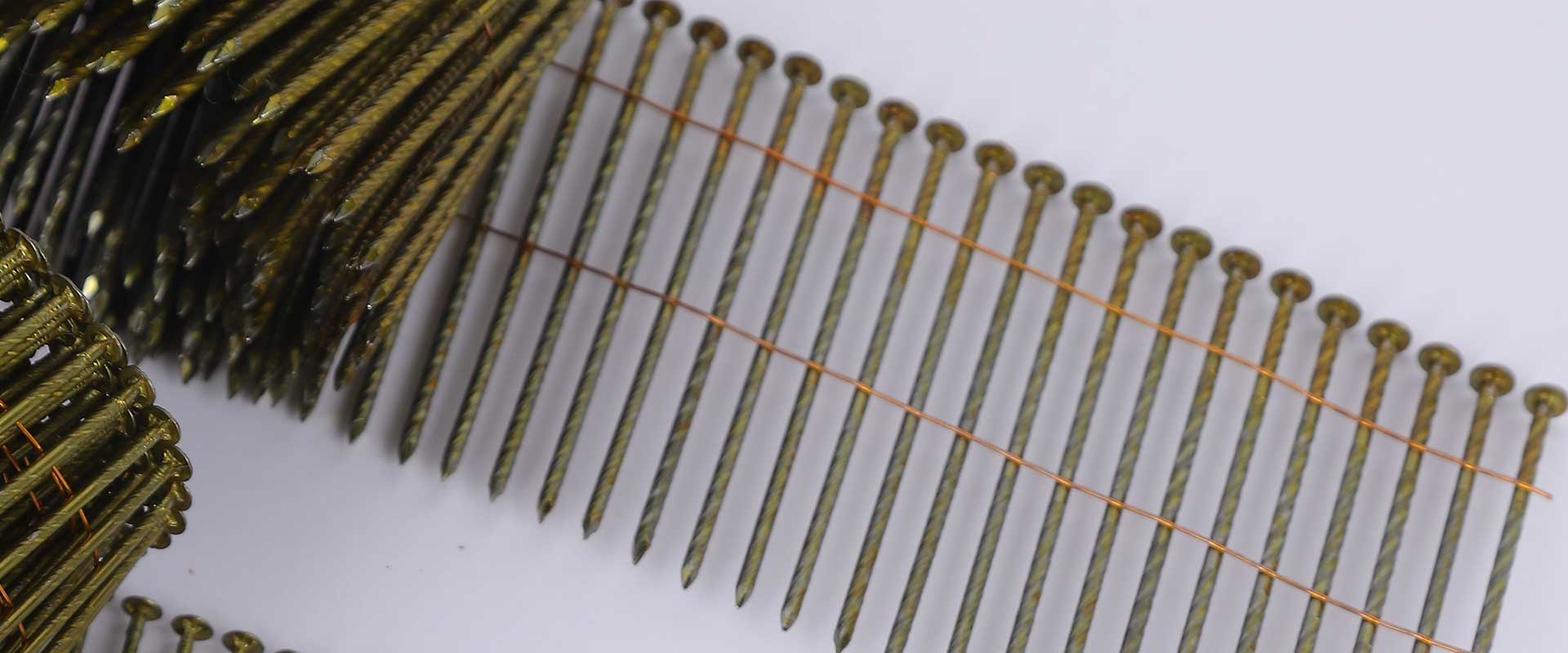
Coil format describes how fasteners are supplied to the tool; pallet nail clinching describes what happens at the joint. Confirm both. The nailer must accept the actual collation, head geometry, diameter, length, and coil configuration. The clinching arrangement must also be suitable for the selected nail and assembled wood thickness.
Do not assume that a conventional pneumatic nailer performs pallet nail clinching just because it can drive the nail through the boards. Obtain the equipment supplier’s instructions for the complete operation, including support and point-forming requirements. Keep hands away from the exit path; never use a hand as backing or improvise an exposed metal support.
Changing shanks for pallet nail clinching requires a specification review, not an assumption that threaded nails are an upgrade. Ask the nail supplier to confirm the proposed fastener for the intended forming operation. Our guide to evaluating a screw-shank changeover addresses the separate question of comparing an alternative shank in a wood joint.
Inspect the Entry Face and the Exit Face
Inspection for pallet nail clinching needs access to both sides of the connection. On the entry side, compare head seating with the approved detail and look for damaged wood or a gap between the members. On the exit side, check the location and shape of the bend against the same reference. Do not sign off from an overhead photograph alone.
Separate a specified clinch from an uncontrolled projecting point. The NWPCA standard addresses protruding fasteners separately and, for block pallets with clinched fasteners, distinguishes points lying parallel to the top deckboard from shiners. Apply the full requirements and the customer’s drawing; this distinction is not permission to leave an arbitrary sharp point exposed.
Create a small photo reference for pallet nail clinching using approved production samples: entry face, exit face, and a side view with a scale. Keep reject examples separately labeled. Photographs help inspectors describe a mismatch, but they cannot establish an allowable pallet load or replace required connection testing.
Use the Defect Pattern to Narrow the Check
When pallet nail clinching becomes inconsistent, preserve the affected samples before changing settings. Record which board thickness, fastener batch, and equipment position produced each result. The following observations suggest checks to make; they are not diagnoses or instructions to keep operating a faulty machine.
| Observation | Check first | Avoid assuming |
|---|---|---|
| Point does not emerge where expected | Actual stack thickness, nail length, and seating | A longer nail is automatically the correct fix |
| Point emerges but misses the intended bend | Connection position and specified forming arrangement | Successful driving proves successful clinching |
| Results differ between board stacks | Measured thickness and recorded wood condition | All nominally equal boards are interchangeable |
| Heads look correct but underside results vary | Exit-face inspection by equipment position | An entry-side photograph is enough |
| A point breaks or wood splits | Retain the sample for technical and equipment review | More driving force will correct the mismatch |
Stop and follow the equipment’s isolation procedure before adjustments or close inspection. For pneumatic tools, NIOSH safety guidance calls for disconnecting the air hose before clearing jams or maintenance. Investigate one documented change at a time. For pallet nail clinching problems that appear only after a material substitution, compare the actual replacement specification with the approved one instead of treating the carton label as proof of equivalence.
Put the Connection Requirement in the Order
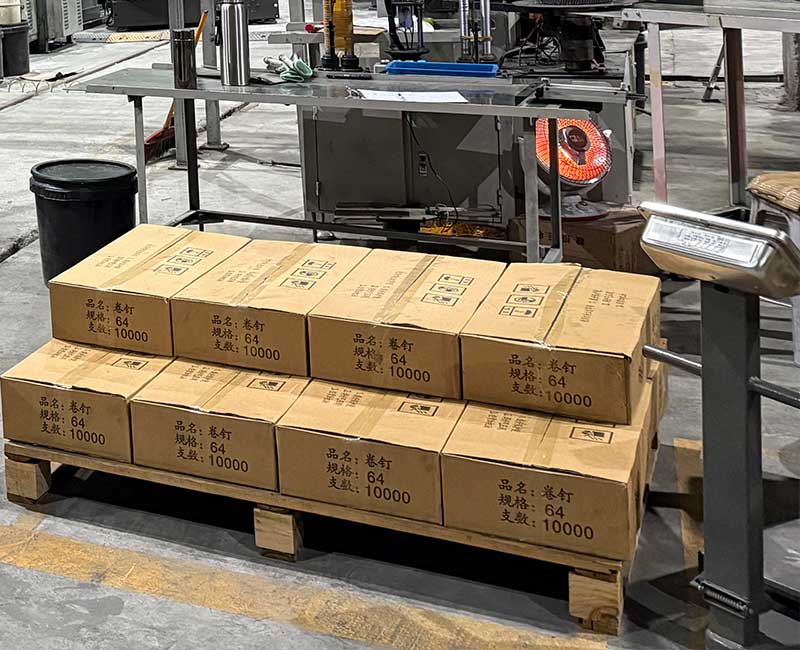
An enquiry for pallet nail clinching should include a connection sketch, wood thickness range, nail drawing, equipment details, and the acceptance reference for the formed point. Identify the pallet joints involved. Keep this information with the sample code so purchasing does not later substitute an ordinary nailing specification with the same nominal length.
Yizhengyu lists plain and threaded options in its coated coil nail range. Ask whether an appropriate specification is available for your pallet nail clinching operation; the listing itself does not certify clinching suitability. Final approval belongs to the defined joint and production process, with the required design or test evidence retained alongside the order.
FAQ
Is pallet nail clinching the same as a bent nail defect?
No. An intentional clinch is specified at a defined connection and formed to an accepted detail. An unintended bend or projecting point must be assessed as a separate inspection finding.
Can any coil nail be used for pallet nail clinching?
Do not assume so. Confirm the full nail specification with the supplier and the equipment requirements with the machine provider. Coil packaging alone does not establish forming suitability.
How much extra length does pallet nail clinching need?
Use the applicable connection specification. The NWPCA 2025 standard includes a minimum 1/4 inch (6 mm) allowance beyond combined component thickness, but length alone does not establish an acceptable clinch.
Does a good-looking clinch prove pallet load capacity?
No. Visual inspection of pallet nail clinching addresses the manufactured detail. It does not replace the design evaluation or performance testing required for the pallet and its intended handling conditions.
What should buyers retain after approving pallet nail clinching?
Keep the joint drawing, wood thickness range, fastener specification, sample reference, equipment details, inspection photographs, and approval basis together. Record subsequent changes rather than relying on the original sample indefinitely.


