

Table of Contents
Coil nail carton weight is useful for receiving checks, but it is not a universal measure of how many nails a box contains. A heavier carton might hold more nails, larger nails, or simply heavier packaging. Before comparing a scale reading with a packing list, establish exactly what each number includes.
This guide helps distributors and production buyers reconcile coil nail carton weight with the agreed contents. It includes an illustrative calculation and a way to investigate discrepancies without immediately assuming a short shipment. The examples are arithmetic demonstrations, not Yizhengyu product specifications, measured production results, or a legal package-compliance procedure.
Coil Nail Carton Weight: Gross, Tare, and Contents
Start a coil nail carton weight review by separating the filled package from its packaging. Gross weight includes the contents and packaging. Tare is the packaging weight removed from that gross measurement to obtain the contents weight. The NIST Handbook 133 glossary provides the underlying definitions. Keep the units consistent throughout the calculation.
For collated nails, write down the measurement boundary. Does the stated contents weight include the collation wire? Which liners, dividers, loose bands, or inserts are treated as packaging? Ask for clarification rather than silently choosing your own convention. A supplier’s assembled-coil weight and a buyer’s bare-nail weight are different quantities even when both are called net weight in an email.
Do not compare a pallet-scale result directly with coil nail carton weight. Pallets, stretch wrap, straps, and other shipment materials belong to another packaging level. Record them separately so their mass is neither omitted nor subtracted twice when reconciling the delivery.
Keep the Packing List and the Scale on the Same Basis
A coil nail carton weight on a packing list may be an expected value rather than an individual measurement. Ask which it is. Also confirm whether an entry refers to one carton, a group of cartons, or the complete shipment. Record kilograms or pounds explicitly; a number without a unit is not a usable inspection result.
A useful coil nail carton weight comparison starts with like-for-like cartons. Keep nail size, shank, finish, collation, declared count, and packaging revision together. If several specifications share one delivery, separate them before averaging. One overall average can conceal a mismatch between two product groups. Our export carton and pallet packaging guide covers the separate questions of physical protection and shipment identification.
Build a Reference From the Actual Product
To interpret coil nail carton weight, use a reference from the same finished nail specification and a documented lot. Do not borrow a grams-per-nail figure from a different length or diameter. A calculation based on the wrong reference can produce a convincing-looking count that is still wrong.
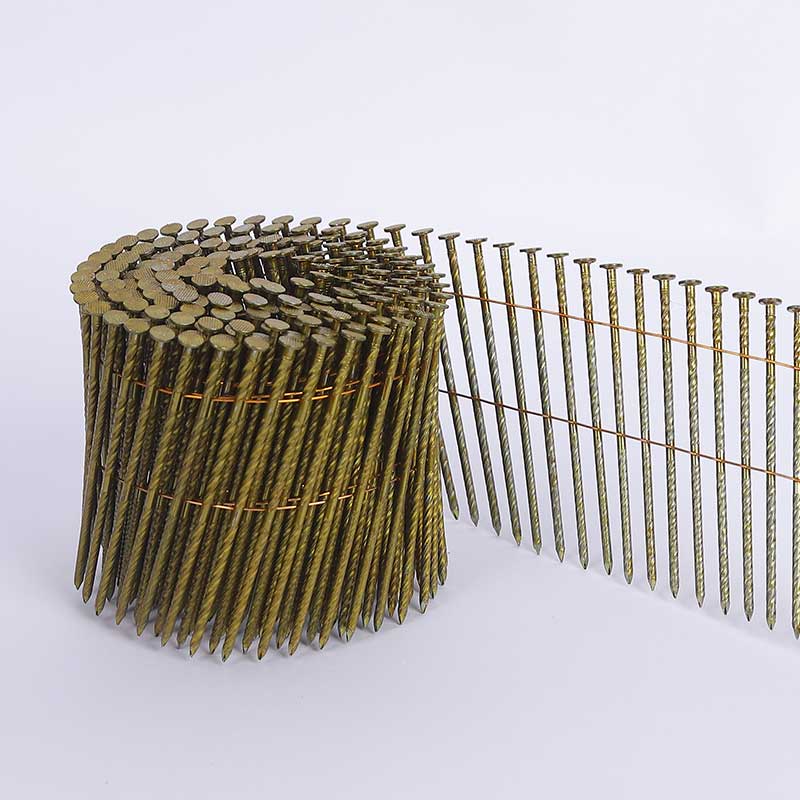
Count the reference contents and weigh them on the same basis as the carton contents. If the carton measurement includes collation wire, the reference must account for it consistently. Record what was retained or removed. Use appropriate handling precautions around exposed points and wire; a receiving check should not require operating a nailer.
Confirm that the weighing equipment suits the load and the difference you need to detect. Check its operating condition, zero indication, units, and the documented verification process used by your quality team. Extra decimal places on a display are not, by themselves, evidence that a coil nail carton weight comparison is accurate.
Work Through One Carton Without Mixing Units
The following hypothetical coil nail carton weight example uses a counted reference measured on the same basis as the contents. It demonstrates the calculation only. The chosen masses and counts are not a standard packing format, a recommended sample size, or an acceptance tolerance.
| Quantity | Illustrative value | Meaning |
|---|---|---|
| Filled-carton gross mass | 18.60 kg | Carton, packing materials, and contents |
| Removed packaging mass | 0.60 kg | Tare for the defined measurement boundary |
| Contents mass | 18.00 kg | 18.60 minus 0.60 |
| Counted reference | 1,000 nails | Same product and treatment of collation |
| Reference mass | 1.80 kg | Mass corresponding to the counted reference |
| Estimated carton count | 10,000 nails | 18.00 divided by 1.80, multiplied by 1,000 |
The general relationship is: estimated count = contents mass divided by reference mass, multiplied by reference count. For this coil nail carton weight example, the units cancel because both masses are in kilograms. Mixing grams with kilograms without conversion would make the answer meaningless.
Now change only the packaging. If its mass rises from 0.60 kg to 0.80 kg while contents remain at 18.00 kg, gross mass becomes 18.80 kg. The higher coil nail carton weight does not indicate additional nails. Conversely, an unchanged gross reading can hide a contents difference if the packaging has changed.
Know When Weight Cannot Establish the Count
An estimate derived from coil nail carton weight depends on the reference representing the contents. Mixed nail sizes, inconsistent reference preparation, or variable packaging can undermine that comparison. When the evidence does not support a reliable conversion, count the relevant contents using an appropriate agreed method instead of adding more decimal places to the estimate.
NIST Handbook 133, Chapter 4 describes weight-based procedures for certain packages labeled by count. It requires attention to equipment sensitivity and item-weight variation; excessive variation requires counting rather than weighing. Refer to the complete applicable procedure for formal testing. The simplified arithmetic here does not establish regulatory compliance or a universal tolerance for coil nails.
A normal coil nail carton weight also cannot demonstrate correct dimensions, sound collation, or satisfactory driving behavior. Quantity and product quality need separate checks. A carton can have the expected mass while containing the wrong specification.
Investigate the Pattern Before Reporting a Shortage
When coil nail carton weight differs from the record, identify the carton and preserve the evidence before repacking. Photograph the label, record the scale reading and units, and note whether the carton was sealed, damaged, or previously opened. Keep recovered packaging with its contents so the tare can be checked again.

Look at the pattern across the agreed inspection sample. A consistent shift may justify checking the stated basis or packaging revision first; isolated differences warrant examination of the affected cartons. These are investigation priorities, not proof of a cause. Do not select only the lightest boxes and describe the result as a representative shipment average.
Put the Weight Basis in the Purchase Record
Specify whether coil nail carton weight is informational shipping data or an agreed receiving check. Record the product code, declared count, contents definition, packaging components, units, reference method, and escalation process. Distinguish estimated packing-list values from measured inspection results so the warehouse does not treat them as interchangeable.
For enquiries about Yizhengyu’s coated coil nail range, send the nail specification and required count per carton, then request the matching packing details. Ask for confirmation of the coil nail carton weight basis before approval. This makes a later discrepancy a specific question about measurable quantities rather than an argument over an unexplained number.
FAQ
Is coil nail carton weight the same for every size?
No. Nail dimensions, declared quantity, collation, and packaging can differ. Compare the actual specification and packing format instead of assuming one standard carton mass.
Does a heavier carton always contain more nails?
No. Coil nail carton weight includes packaging when expressed as gross weight. Larger individual nails or heavier packing materials can increase mass without increasing count.
Can I calculate a count from coil nail carton weight alone?
Not reliably. Establish the contents mass and a representative counted reference on the same measurement basis. Treat the result as an estimate unless the applicable verification procedure supports it.
Should collation wire be removed from the reference?
Use the same defined basis for the reference and the carton contents. Mixing bare-nail reference mass with assembled-coil contents mass introduces an inconsistency. Clarify the agreed net-content definition first.
What should accompany a coil nail carton weight discrepancy report?
Include carton and lot identifiers, product specification, declared count, gross and tare measurements, units, equipment details, packing condition, and photographs. State which figures were measured and which were estimates.


